
Bath County Deed Types and Uses
The Bath County Circuit Court Clerk records deeds and the instruments that travel beside them. One document conveys. Another secures or releases. A deed transfers whatever interest the instrument describes. A deed of trust backs a loan. A release or satisfaction shows that an earlier security interest was cleared. A plat, by contrast, records a map or subdivision description. The required review is complete first.
| Instrument | What the Document Does | Common Research Use |
|---|---|---|
| Warranty or special warranty deed | Transfers the interest stated by the grantor | Confirm a conveyance and its legal description |
| Quitclaim deed | Conveys whatever interest the grantor holds, if any | Review a corrective, family, or title-related transfer |
| Deed of trust | Creates a security interest tied to real estate | Identify a recorded loan instrument |
| Release or certificate of satisfaction | Records discharge of a prior obligation | Check whether a lien instrument has a later release |
| Plat | Shows mapped lots, easements, roads, or dedications | Connect a lot and block to a parcel description |
Wording controls. A deed label or party name in an index only points you toward the filed instrument, and the instrument deserves a full read. Bath's Clerk also keeps probate, fiduciary, marriage, and court records, but the land-record portion remains the source for recorded conveyances in Bath County.
Search Bath Deeds by Grantor and Grantee
The grantor conveys the interest. The grantee receives it. Virginia land-record searching leans on party names and recording references, so start with the known owner as grantee to locate the acquisition deed. Note the prior grantor and the book/page or instrument number. Then search that earlier grantor as grantee to reach the next conveyance back. The method builds a backward chain, not a complete guarantee of ownership.
- Choose Bath in Virginia SRA if the court is available and search the known party name.
- Record party role, instrument type, recording date, and book/page or document number.
- Open or request the instrument and read its legal description and parcel references.
- Compare the description with the assessment parcel and any recorded plat.
- For an older chain, continue through the Library of Virginia grantee index and deed books.
Grantor and granteesimply mark opposite ends of one transfer. When the index is open by name but the image sits behind a gate, the index entry still gives the Clerk's office or a subscription request a concrete lead to work from.
Bath County SRA Search Fields
Virginia SRA is the statewide gateway to land records held by circuit-court clerks. Its public help describes an Available Courts step and a standard search workflow. Bath County field labels vary by court, so treat any unlisted field with care rather than assuming a fixed screen layout.
| Visible or Reported Field | Type | Required | Bath-Specific Note |
|---|---|---|---|
| Available Courts | Court list or selector | No | Select Bath if enabled |
| Grantor or grantee name | Party-name search | Not stated | Exact syntax and options not captured |
| Instrument type | Search filter | Not stated | Bath dropdown options not verified |
| Recording date range | Date filter | Not stated | Field labels not captured |
| Book/page or document number | Reference search | Not stated | Confirm local index convention with Clerk |
Try name variants when a common surname floods the results. Compare legal descriptions across matches. A parcel number cross-reference helps narrow things, though Bath's APN formatting is not a universal standard.
Bath SRA Index and Image Access
The Virginia court system treats index access and image access as two different things. Some participating clerks open free index-only searching with no login. Images may call for a subscription agreement authorized by the local clerk, plus a fee. Bath's cutoff year, subscription terms, and copy schedule rest with the Clerk's office. The Virginia SRA access explanation lays out that distinction on the statewide help page. An image may stay closed online. Ask the Circuit Clerk about the public record room and authorized copy options.
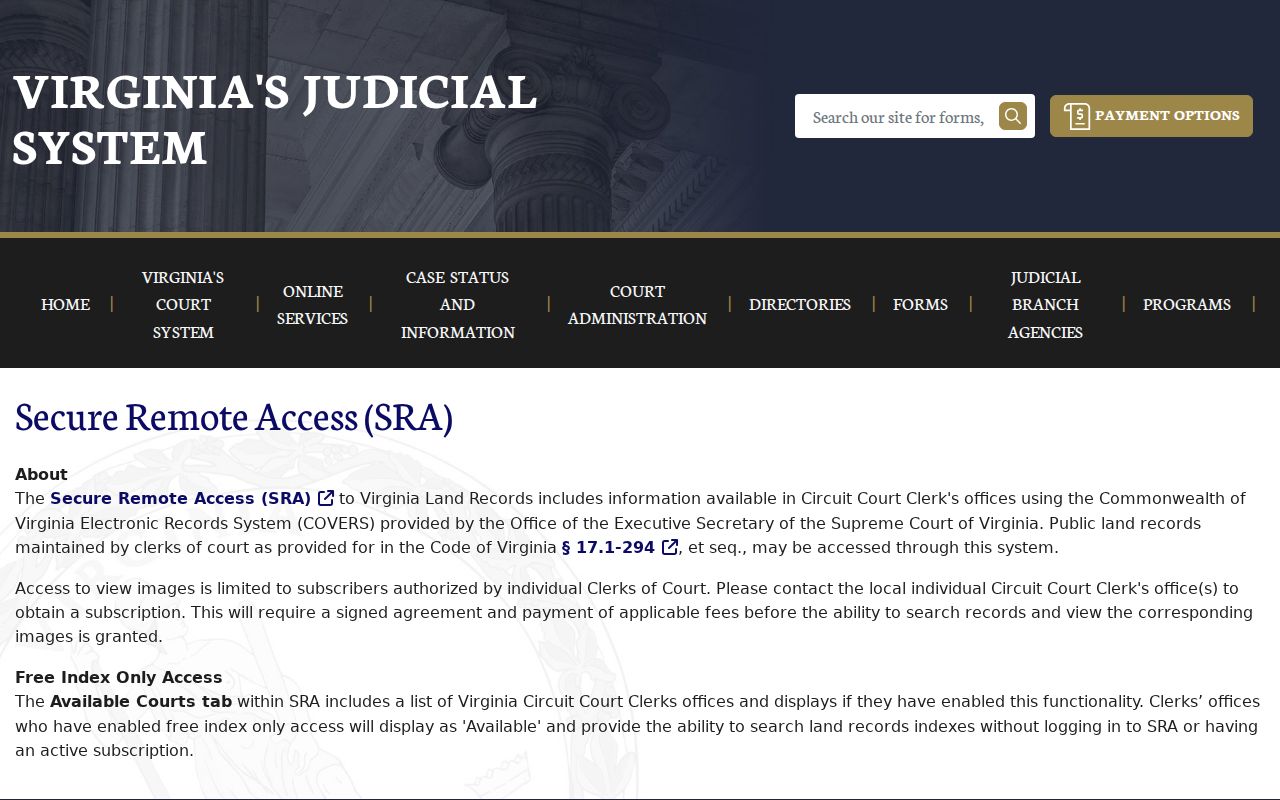
Hang on to the instrument reference from the index so a clerk can pull the right page without another broad name search. The Virginia SRA land-record gateway is the entry point for selecting the Bath court and searching the index.
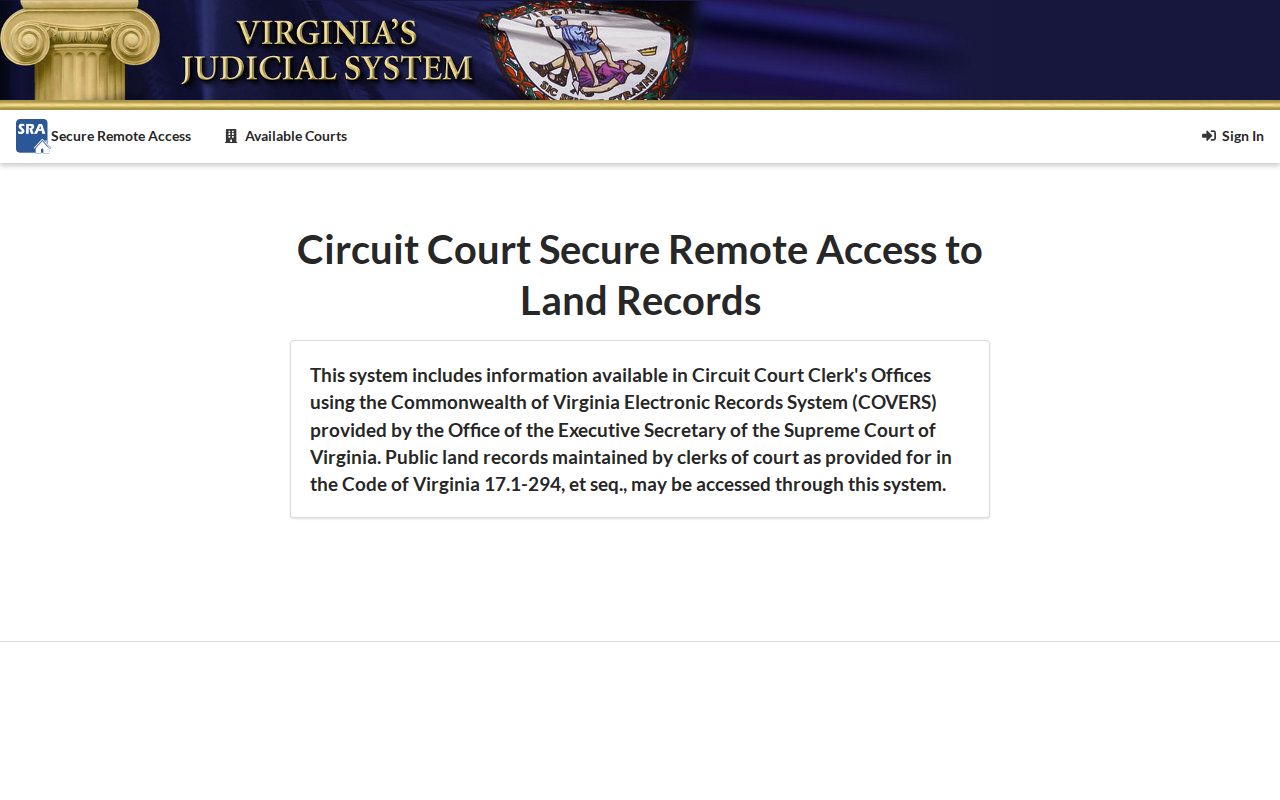
The gateway screen is a portal view. It does not mean every Bath deed image is open to each visitor.
Bath Clerk Records Since 1791
The Bath County Circuit Clerk describes a record depository dating to 1791. It serves the public, attorneys, title searchers, and genealogists. The office sits at 65 Courthouse Hill Road in Warm Springs. Hours run 8:30 a.m. to 4:30 p.m., with a last recording time of 4:00 p.m. These details describe the walk-in office rather than the reach of online image access. The clerk's page lists land records. Beside them sit wills and fiduciary records, marriage licenses, and court records. Probate and marriage licensing work by appointment, so confirm those services before visiting. For deed copies, ask about the book/page, image access, certification, and fee. The Bath Circuit Court Clerk page describes the local office and record room.
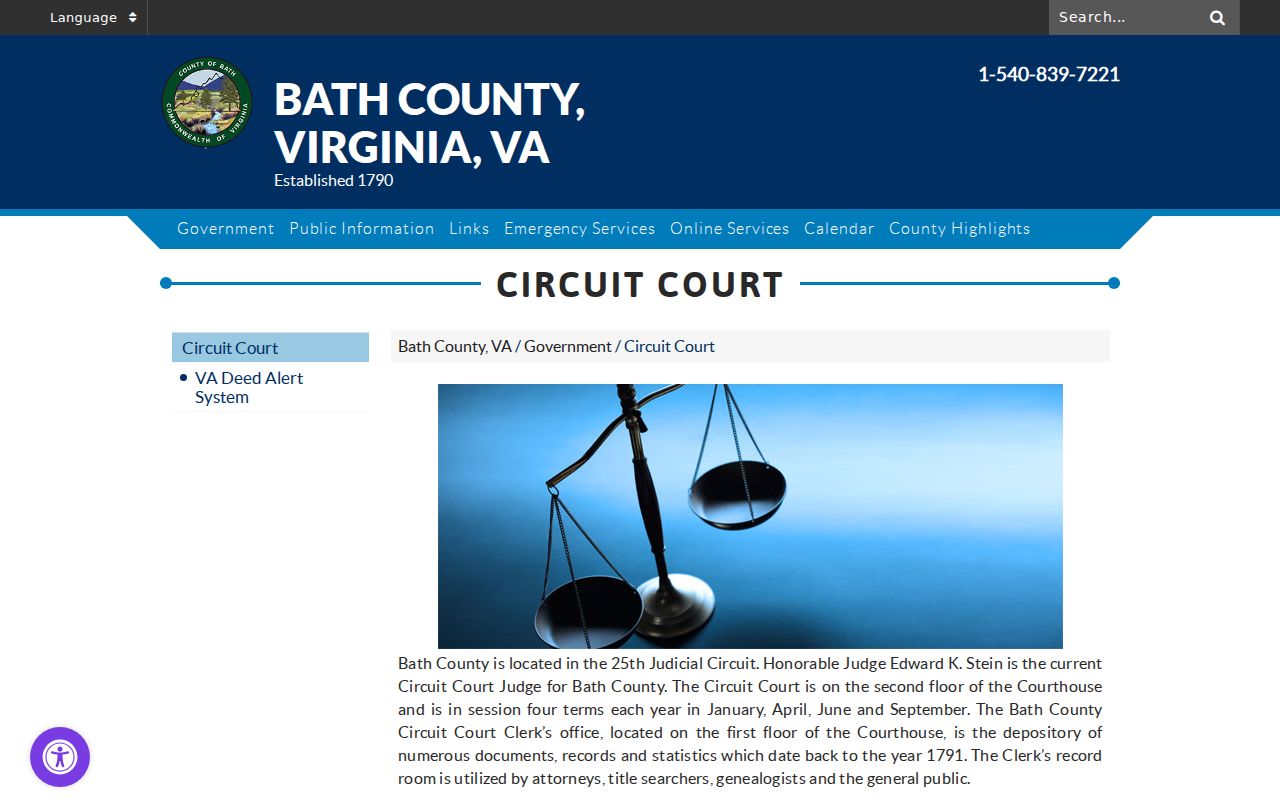
Ask the Clerk when an in-person search or copy request is needed. SRA does not display every image.
Bath’s 1791 to 1903 Grantee Index
The Library of Virginia catalog covers Bath Deed Books 1 through 19. These span 1791 to 1901. The catalog also holds a General Index to Deeds, Grantee. That index reaches 1903. The span is archival, not the modern SRA cutoff. Pick a volume in the catalog first. Then follow its reel, page, and indexing notes. The index locates a name. The book page holds the actual instrument.
Book 2 shows why old catalog records deserve a close read. Its formal dates run 1791 to 1804. Yet pages 1 through 229 carry voter lists for 1791 to 1821. Deed entries do not start until page 230, and they run through page 610. Anyone who assumes every page in a deed book holds deeds risks misreading the source. The LVA catalog also lists wills, fiduciary records, naturalization papers, medical registers, and election material. That helps when a name drops out of the land index.
Early Bath descriptions often name roads, runs, ridges, farms, and adjoining landowners. They rarely use a modern street. Keep every name and location clue as the chain moves backward. Start with the Library of Virginia Bath finding aid for the full historic collection index.
Bath Plats and Legal Descriptions
Every deed needs a legal description of the land it conveys. The description may rely on metes and bounds. It may also cite a survey, acreage, a watercourse, a road, or an adjoining owner. A plat maps subdivision lots, blocks, easements, dedications, and dimensions. A tax map or historic plat is still not a current boundary survey. Match any plat to the instrument that cites it.
Bath plats need zoning-administrator review and sign-off before filing with the Circuit Clerk. Planning and Zoning publishes subdivision and addressing materials, while the Clerk keeps the recorded plats. The two offices serve different roles. A plan sent in for review is not always a recorded plat. Confirm the book and page or recording reference before relying on it.
For a difficult tract, give the Clerk the road, acreage, adjoining owner, route, and parcel number. Do this instead of just a mailing address. A deed description may cross a county line. Search each clerk's land records on its own side.
Probate Deeds and Bath Property
Some Bath County ownership trails pass through probate. The Circuit Clerk handles wills and fiduciary records by appointment. The Library of Virginia catalog adds will books with indexes, an index to devisees and lists of heirs covering 1909 to 1982, and an estate inventory volume for 1894 to 1915. Those sources can reveal authority, heirs, debts, and land references. A will alone does not always carry out the conveyance. An executor's or commissioner's deed performs that.
When a deed chain seems to skip a generation, search the decedent's will or fiduciary file. Then hunt for a deed, partition order, or sale instrument. Run the decedent, heir, executor, and trustee names through SRA too. Certified death records come from the Virginia Department of Health instead. VDH access rules apply and must be checked there.
Bath probate records can explain why a roll name differs from an older deed. Private details may be redacted, though. The assessment roll may also lag behind the recording date.
Limits of Bath County Deed Records
An index entry is not a title report. A deed's grant, reservations, exceptions, signatures, legal description, and recording details all need to be read in context. That means reading the whole instrument. A search can miss a spelling variant or an entity name. It can also miss an older book, an unindexed item, or a document filed in a neighboring county. Check any recorded release separately from the original deed of trust or lien.
Bath deed records support property research and title review, but they will not settle a disputed boundary, guarantee that no instrument is missing, or certify clear title. They are a starting point, not a final word. Use the record room, the LVA catalog, the Treasurer, GIS, and Planning and Zoning as needed. Combine them where a question needs depth. For legal conclusions, consult a title professional or surveyor.