
Trace Former Bath County Owners
Start a backward chain with the most recent deed tied to the parcel. Anchor each earlier transfer to a recorded instrument and the legal description. A name alone is not proof. Two entries that share a surname may describe entirely different tracts. Keep the table as a working log of Bath County deed records. Fill it only from the recorded documents themselves.
| Recording Date | Grantor to Grantee | Instrument | Book, Page, or Number |
|---|---|---|---|
| Latest verified filing | Copy the recorded parties | Read the deed type | Enter the Clerk’s reference |
| Prior acquisition | Search the grantor as grantee | Confirm the land description | Record exact reference |
| Older transfer | Continue with prior grantor | Note estate or trustee role | Mark source and date |
| Historic volume | Use the grantee index by name | Check deed-book page | Record reel or book reference |
Rebuild the chain one transfer at a time. A quitclaim, fiduciary deed, or commissioner's deed plays a different role than a warranty deed. So log the instrument type and each party's capacity along the way.
Walk Backward Through Bath Deeds
A grantor conveys the interest. A grantee receives it. To trace former Bath County owners, begin with the most recent deed you can trust. Then walk backward through the grantor-grantee index one entry at a time. Match each deed's legal description against the last. That is the only way to know the same property is still in play. This is history work, distinct from confirming today's owner of record or ordering one certified copy.
- Locate the newest deed that matches the parcel and copy its grantor, grantee, date, and reference.
- Search the named grantor as grantee to find that party’s acquisition deed.
- Compare acreage, road, adjoining tracts, and legal description in both instruments.
- Repeat with the earlier grantor, noting trusts, estates, and representative roles.
- When the online result ends, move to the Clerk’s room and LVA book or index.
Bath descriptions often name a farm, stream, ridge, or adjoining owner instead of a street address. Keep every such clue in the chain log. Those details let you match an old deed to a modern parcel.
How Far Bath County Deeds Reach
Bath County's record depository dates to 1791, according to the Circuit Clerk. The Library of Virginia catalog extends the paper trail further, listing Bath deed books 1 through 19 covering 1791 to 1901, plus a General Index to Deeds, Grantee, running from 1791 through 1903. Those dates give researchers a concrete historical fallback. They do not, however, prove the first year available in Virginia SRA or guarantee a digital image for every volume.
The county publishes no exact modern SRA index cutoff. Before concluding that an older owner simply is missing, ask the Clerk whether Bath appears in SRA for the period you need, whether images are enabled there, and which index or book to search. Bath County's archive span and its online coverage are two separate facts.
Coverage caution. Bath’s verified LVA grantee index runs through 1903; the web-index cutoff remains unconfirmed and should be checked with the Clerk.
Bath Deed Books and Index Quirks
The Bath finding aid hides a useful oddity. Deed Book 2 spans 1791 to 1804. But pages 1 through 229 hold voters lists from 1791 to 1821. The deeds themselves sit on pages 230 through 610. A volume's title alone never tells you what fills its pages. So read the catalog note before requesting a page or reel.
The Library of Virginia lists the general grantee index along with Bath's deed-book runs. Each entry shows the reel number and record group. It also gives the title, date range, volume, page count, and index note. A catalog entry is a finding aid, not a transaction result. Only the deed page itself can confirm the parties and the land. Consult the LVA Bath County collection to identify a historic volume and its access path.
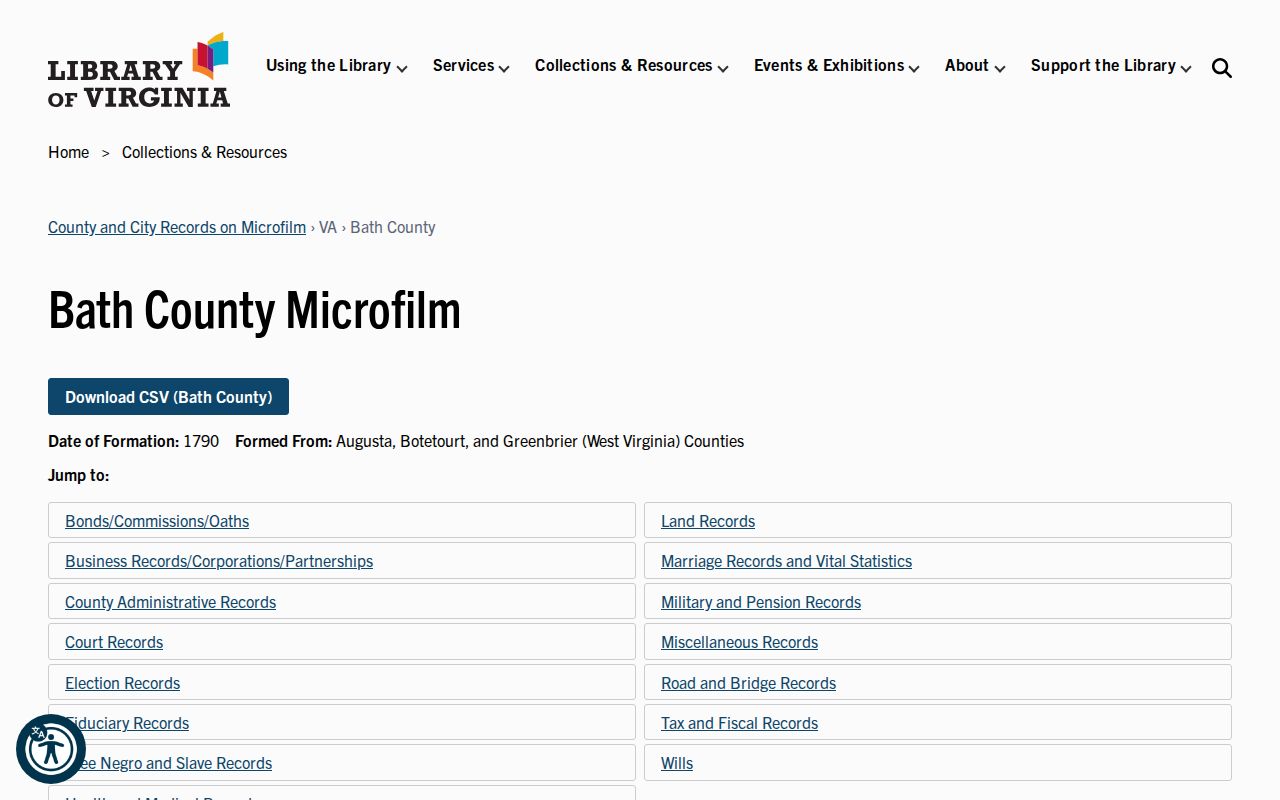
Use the catalog note to request the correct reel. Then tie the indexed name to a deed page and its legal description.
When a Bath Address Disappears
Older Bath deeds may describe land by a road, run, ridge, spring, acreage, or the adjoining owner. A modern situs is often missing from this wording. A current assessment card, by contrast, may show a route or street address. The two can describe the same land despite the different wording. List every place name, watercourse, neighbor, acreage figure, and survey reference each transfer contains.
Local geography adds clues. Warm Springs deeds can mention the courthouse town, the springs, village lots, or nearby farms. West Warm Springs records may cite Route 39 and community institutions. Historic names help place the context. The instrument and plat decide what tract was actually conveyed.
For a parcel that resists placement, the Clerk wants more than a modern address. Give the road, the acreage, the adjoining owner, and the route number. If the deed crosses a county line, search the neighboring county clerk too.
Probate in a Bath Owner Chain
Not every link in a Bath County owner chain comes from a sale. Some transfers run through an estate instead. The Bath Circuit Clerk handles probate by appointment. The Clerk keeps the wills along with fiduciary records. The Library of Virginia catalog adds more: will books and indexes. It also holds an index to devisees and heirs through 1982, fiduciary material, and an estate-inventory volume covering 1894 to 1915. An executor, administrator, or heir can surface there. So can debts and references to land.
When a death sits behind a transfer, start with the will or fiduciary index. Search it under the decedent's name. Pull out any mention of land. Then hunt for the instrument that actually moved title. An executor's deed, commissioner's deed, partition order, or probate sale may be the operative record. The will alone often is not. If the file names representatives or heirs, search them as parties in the land index too.
Virginia's Vital Records office, part of the Department of Health, keeps certified death certificates. A certificate is separate from a Bath County will, fiduciary file, or recorded deed. It can clarify who a person was. But the estate or land instrument still proves the transfer. Eligibility, identification, fees, and processing rules shift, so rely on the current state application. The Virginia VDH Vital Records page is the official route for present certificate information.
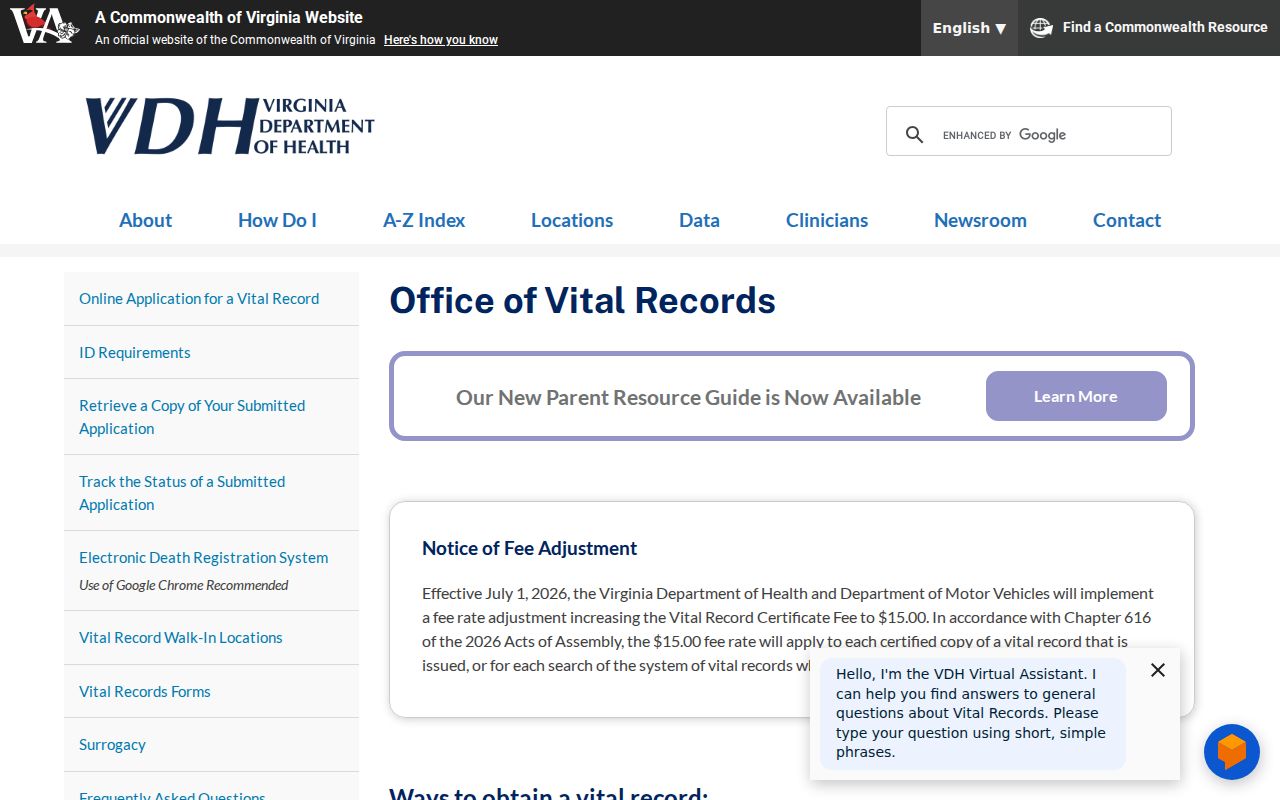
A death certificate helps pin down identity. It cannot prove a transfer. Only the recorded estate or land instrument carries that weight in Bath County.
Bath County Record Room Fallback
Virginia SRA may lack the year or image you need. Fall back on the Bath County Circuit Clerk's public record room. The clerk's own page says records go back to 1791. The official court page posts hours of 8:30 a.m. to 4:30 p.m. There is a 4:00 p.m. cutoff for last recordings. Call (540) 839-7226 or 7227 to ask about the right index. You can also ask about an older volume, copy charges, or whether a record group needs an appointment.
The Library of Virginia catalog and its microfilm offer another path into the historic books. Bath County Library may assist with local history, newspapers, and genealogy. Its exact holdings are not confirmed. Ask for the title, reel, and date span. Also ask whether interlibrary loan or an on-site review is possible. Save your result source and page number. A later search can then resume from the same entry. The Virginia Courts' Bath Circuit Court page lists the Clerk's current contact information.
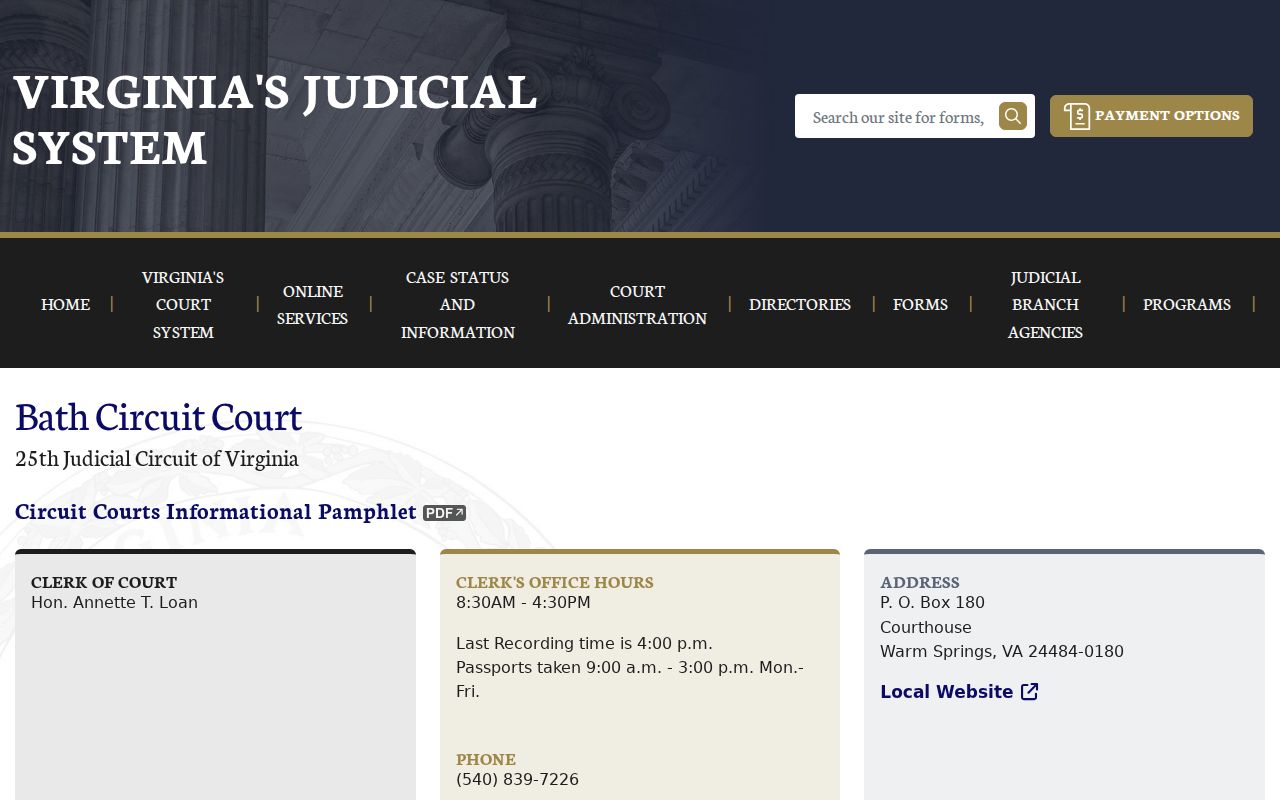
The court page gives contact details only; it does not show the historical deed chain itself.
Terms in a Bath Deed Chain
These record terms make an older-owner search easier to follow.
- Grantor
- The party conveying the interest described in a deed.
- Grantee
- The party receiving the interest named in that deed.
- Chain of title
- The sequence of recorded transfers for the same land.
- Reverse index
- A search path from a grantee to the earlier grantor who conveyed to them.
- Book and page
- A local reference used to locate an instrument in a record volume.
Never stop at a familiar surname in a Bath County deed chain. Compare each property description closely. Check whether the grantor signed as an individual, a trustee, an executor, or a company representative.
Limits of Bath Former Owner Research
A former-owner list can turn out incomplete. An index period may be missing. Names may be spelled several ways. A probate transfer may never have been followed into the deed record. Remember that a deed index only identifies a filing. It does not guarantee every recorded interest has surfaced. Confirm modern Bath County SRA coverage and image access with the Clerk.
Former-owner research suits property history, purchase diligence, and estate work. It is no substitute for a title search. Before treating a chain as one property, check the details closely. Make the parcel description, adjoining land, book reference, and transfer dates all agree.