
Who Owns a Bath County Property?
The fastest route runs in four steps. Start with an address. Get the parcel, and read the assessment owner. Confirm it with the deed. The Commissioner of Revenue links Bath County assessment data to ACT DataScout and advertises owner-name search. Check the live card for the exact owner label and its date. Keep this in mind. A name on the tax roll serves tax administration; it is not a ruling on every legal interest in the property.
- Search the known address or owner name in ACT DataScout.
- Copy the parcel number, legal description, and any owner or mailing details actually shown.
- Locate the parcel in the county GIS viewer to confirm the physical tract.
- Search Virginia SRA for the latest deed naming the owner as grantee.
- Read the recorded instrument and compare its legal description with the parcel record.
That sequence gives any researcher both an answer and a path back to the source record. If the portal is down, the Commissioner and the Circuit Clerk are the local fallback.
Bath County Owner Record Sources
Each Bath County office answers a different slice of the ownership question. The Commissioner lists the owner for tax purposes. The Circuit Clerk records the deed that conveys the interest. GIS maps the parcel itself. The Treasurer handles bills and liens, though a tax account never transfers title. The source table below keeps those roles straight.
| Source | What It Can Establish | How Current |
|---|---|---|
| ACT DataScout / Commissioner | Assessment owner and parcel context, as displayed on the live card | Refresh schedule not published in reviewed material |
| Virginia SRA / Circuit Clerk | Recorded party names and deed references; image access varies | Recording and indexing dates must be checked |
| Bath GIS viewer | Mapped parcel location and planning context | Map currency and layers should be verified |
| Treasurer | Tax bill, payment, delinquency, and lien work | Ask for the current account status |
A current-owner answer requires the assessment entry plus the newest relevant deed. The Bath County current owner record explains how to read and confirm the present owner field.
Bath County Assessment Owner Field
Bath County's Commissioner page routes the "View Real Estate Assessment data" option to ACT DataScout. The portal requires a live visit to see the owner field, the card date, and how often records refresh. Treat any owner label as something to verify on the current card. If the entry is unclear, call the Commissioner at (540) 839-7231 with the parcel or address in hand.
ACT DataScout is an assessment tool, not the deed book. It can supply the parcel reference that speeds up a recorder search. Compare the assessment against the deed using the same parcel and legal description, so a nearby tract or a same-name owner cannot throw off the result.
Bath County Mailing and Situs Clues
Situs is where the property sits. The mailing address is where the county sends the bill. They often differ. An owner may use a post office box or live out of state. The owner may hold title through an LLC. Some owners have an estate representative handle the mail. A mailing address helps explain contact routing. It says nothing about who lives on the land.
Bath County's rural geography adds community names and route numbers. Warm Springs, Hot Springs, Millboro, Williamsville, and Mountain Grove show up in postal wording. An older deed may describe the land by road, stream, farm, or adjoining owner instead. Keep the exact wording from both the assessment and the instrument. A ZIP code does not define the tax district or a parcel boundary.
The county e-Treasurer and e-Commissioner service lists property-card and mailing-address options. The official county service page shows the lookup path rather than an owner result.
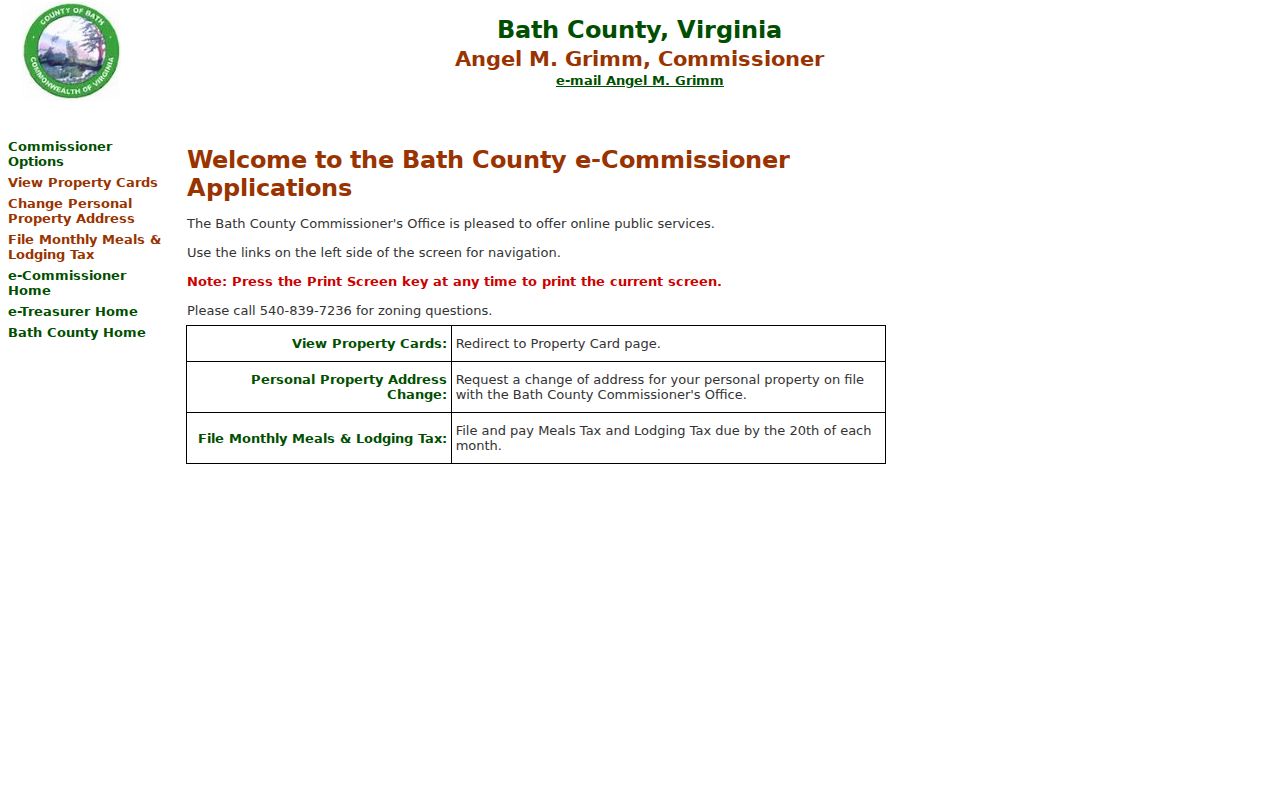
Use that service to locate the right county record. Then confirm any owner information against the Clerk's recorded instrument.
Confirm a Bath County Deed
Virginia SRA offers an index gateway for participating circuit courts. Search by owner or transaction party. Note the grantor, grantee, recording date, book/page or document number, and legal description. SRA's statewide help notes that index-only access may be free where enabled. Document images require local-clerk authorization and may carry a fee.
If the deed image is not online, call the Circuit Clerk at (540) 839-7226 or 7227. You can also visit the public record room in Warm Springs. Ask for the instrument by book/page or index reference. A freshly recorded deed can post before the assessment owner field catches up. Bath County publishes no fixed lag. Compare recording dates rather than assuming the tax roll is current.
To trace a prior owner, work the deed chain backward. Use the grantee index and the historical books. Each grantor becomes the next party to investigate.
Bath County LLC and Estate Owners
Bath County parcels are not always assessed to a living person. A deed may name an LLC instead. It could also name a trust, an estate, a trustee, or a personal representative. When that happens, search the exact entity name and try likely punctuation variants. A fiduciary shows up in the record for a reason. That person is authorized to act for an estate. The fiduciary does not own the land outright. Life estates complicate things too, splitting present use from a future remainder interest.
When an LLC holds the parcel, the Virginia State Corporation Commission adds useful context. The Virginia SCC entity search shows the legal name, status, registered agent, and filed address. Confirm those details, then return to the deed to see which party actually took title. SCC filings identify the entity. But they prove neither the property it owns nor who holds beneficial interests. For deaths, estate and will records can explain how the land passed. Check the Bath Clerk and the Library of Virginia.
An LLC listed as owner raises a fair question. Who stands behind the entity name? Estates open another door. The Library of Virginia catalog points to Bath County probate materials. Its holdings include will indexes and books, a devisees-and-heirs index covering 1909 to 1982, fiduciary records, and an estate-inventory volume from 1894 to 1915.
Probate work in Bath County runs through the Circuit Clerk by appointment. A will can name the personal representative. An inventory can point to a land reference. Follow that with the land records themselves. Confirm the operative deed or court order before drawing any conclusion about the interest held.
Keep one caution in mind. Estate papers explain a name in the record. They do not settle who lives on the property today. Match the representative's role to the parcel and the instrument. Only then describe the current owner of record with confidence.
Parcel Numbers Link Bath Records
A parcel number is the thread that ties Bath County systems together. The Commissioner's portal, the GIS map, and the deed index may each render the reference a little differently. So may the tax ticket and the plat. Copy the identifier exactly, punctuation and all. Bath County sources describe no universal parcel syntax. So resist guessing at a pattern from one example elsewhere.
Check the number against the legal description too. Look at the road, the acreage, and the adjoining tract. Parcels get split and combined over time. An older deed may describe only part of what a current tax map shows. Near the Highland County line or another boundary, a community name alone will not settle the question. Which clerk recorded the instrument remains unclear.
The strongest match spans two record types. The same tract may appear in both a recorded deed and an assessment card. When that happens, the owner identity holds up. Two records sharing a name prove far less.
Bath County Historic Owner Trails
Bath County land records reach back to the first court era. The Circuit Clerk holds records from 1791. The Library of Virginia catalog lists Bath deed books 1 through 19. It also lists a general grantee index running through 1903. The online deed records sometimes leave a gap in the chain. These older volumes often close it. Do not read a modern SRA cutoff into the LVA collection, though. The two end dates are separate things.
Old deeds ask for more than names. A Bath County description may locate land by a spring or a run. It may also cite a ridge, a farm, or a neighboring landowner. Warm Springs and West Warm Springs carry long-standing village landmarks. Their resort landmarks anchor many calls too. The DHR nomination names farms, churches, stores, mills, and schools that help interpret such descriptions. Remember that the nomination itself never establishes current title.
Limits of a Bath County Owner Search
Every owner-of-record result has limits. It is not a title search. It is not a survey. It is not proof of who occupies a home. Assessment records can lag behind a recent deed. An entity can obscure individual interests. A legal description may cover land a map renders differently. Public records also carry confidentiality rules and redactions.
Use Bath County ownership information for sound purposes. These include property due diligence, house history, estate research, tax questions, and civic work. Never use a person's name or address to stalk, harass, or expose a protected individual. When title truly matters, have a qualified title professional review the recorded instruments.
Record limit. A Bath County owner entry is a starting point. Confirm the current instrument with the Circuit Clerk before relying on it as title evidence.