
Bath County Search by Address, Owner, Parcel
A Bath County property search runs in steps. The Commissioner of Revenue links ACT DataScout for real-estate assessment data and points to owner-name lookup. Test the known address or owner name there. Then write down the parcel identifier and legal description exactly as shown, with no reformatting.
Once a likely parcel surfaces, the GIS viewer places it among roads and nearby tracts. The Circuit Clerk's SRA index is the next stop for the instrument that transferred ownership. Tax-ticket and lien questions belong to the Treasurer. Each source contributes a different fact. Keep the source name beside every note.
- Start with the property’s current or historic situs wording in ACT DataScout.
- If needed, try the owner’s exact name and reasonable spelling or entity variations.
- Copy the parcel number, situs, mailing address, and legal description shown by the county.
- Compare the map location, then search the Clerk’s index for the deed parties.
- Contact the office when an image, older book, current tax status, or address history is needed.
Choosing a Bath County Search Key
The best first key depends on what you already know. A street address suits a recently assigned situs. An owner name can surface land held by a person or an entity. A parcel number is the strongest cross-reference once verified. Bath publishes no universal parcel-number syntax, so do not read a district or section code into the example “P.N. 2303-03.” Treat that sample as one survey's notation.
| Search Clue | Where to Try It | Strength | What to Check |
|---|---|---|---|
| Situs address | ACT DataScout, GIS | Good starting point | Rural route, renamed road, old number |
| Owner name | ACT DataScout, SRA | Finds a party or holding | Spelling, LLC, trust, estate, same-name person |
| Parcel number | Assessment, GIS, deed reference | Best shared key after verification | Copy exact punctuation and digits |
| Legal description | Circuit Clerk, plat | Tracks the land across address changes | Acreage, road, stream, adjoining owner |
When an address fails, keep the owner, road name, community, approximate acreage, and adjoining tract together in one request. That gives the Clerk more than a street number.
What ACT DataScout Shows in Bath
Bath County's Commissioner page labels the vendor link “View Real Estate Assessment data.” The label names a route. It does not describe every field. Treat the owner, situs, mailing, land, improvement, total value, exemption, sketch, sale, and legal-description items as details to confirm on the live card itself. The card settles what a parcel shows.
| Owner name | Advertised owner-name search; exact result label not captured |
|---|---|
| Situs address | Expected lookup clue; live field and format require verification |
| Parcel or tax-map number | Copy the displayed identifier; Bath syntax is not published |
| Value and tax year | Confirm current labels and year on the result card |
| Sale or deed reference | Do not assume these fields appear without live confirmation |
The Bath ACT DataScout real-property entry is the route into county assessment data. It opens at an entry point, not a sample property.
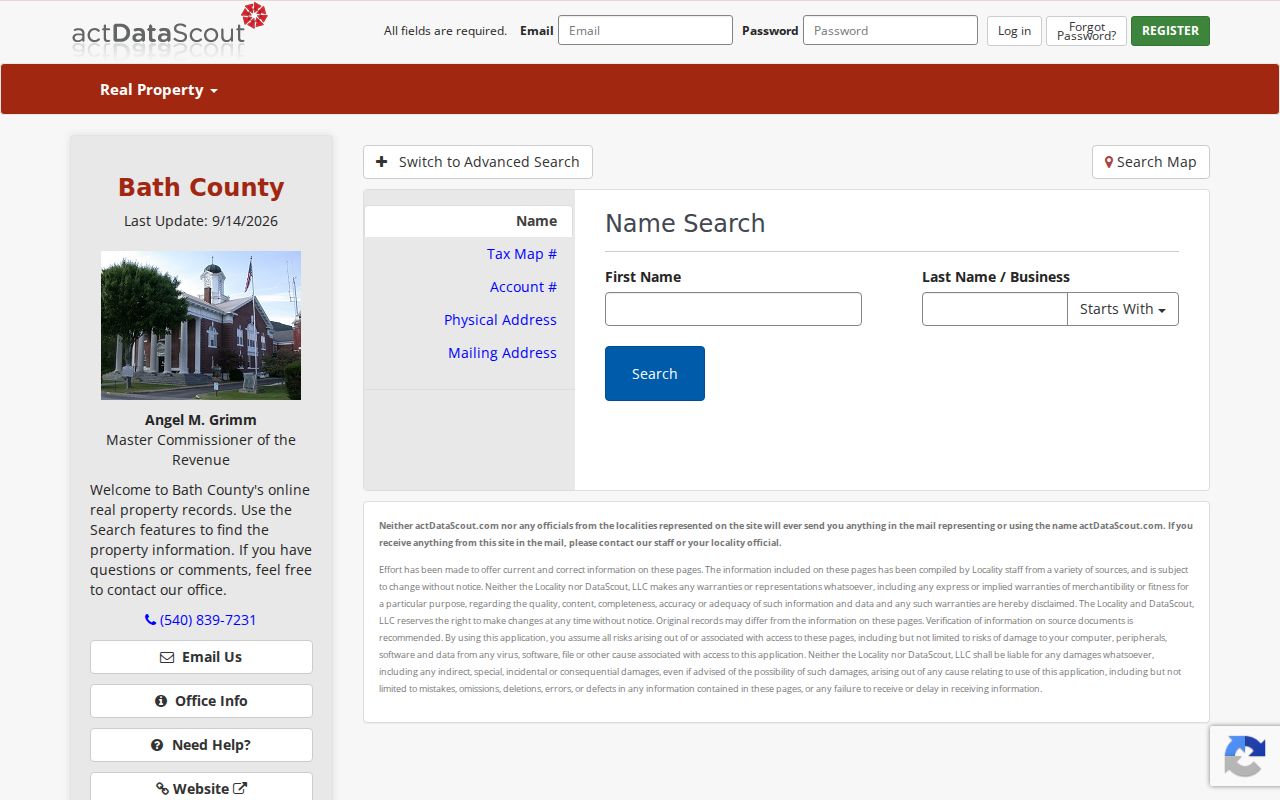
The Commissioner's page at bathcountyva.gov lists the county link. Call (540) 839-7231 if the search stalls. The Commissioner of Revenue page documents the office route behind this search. It marks where a person begins, not a single parcel result.
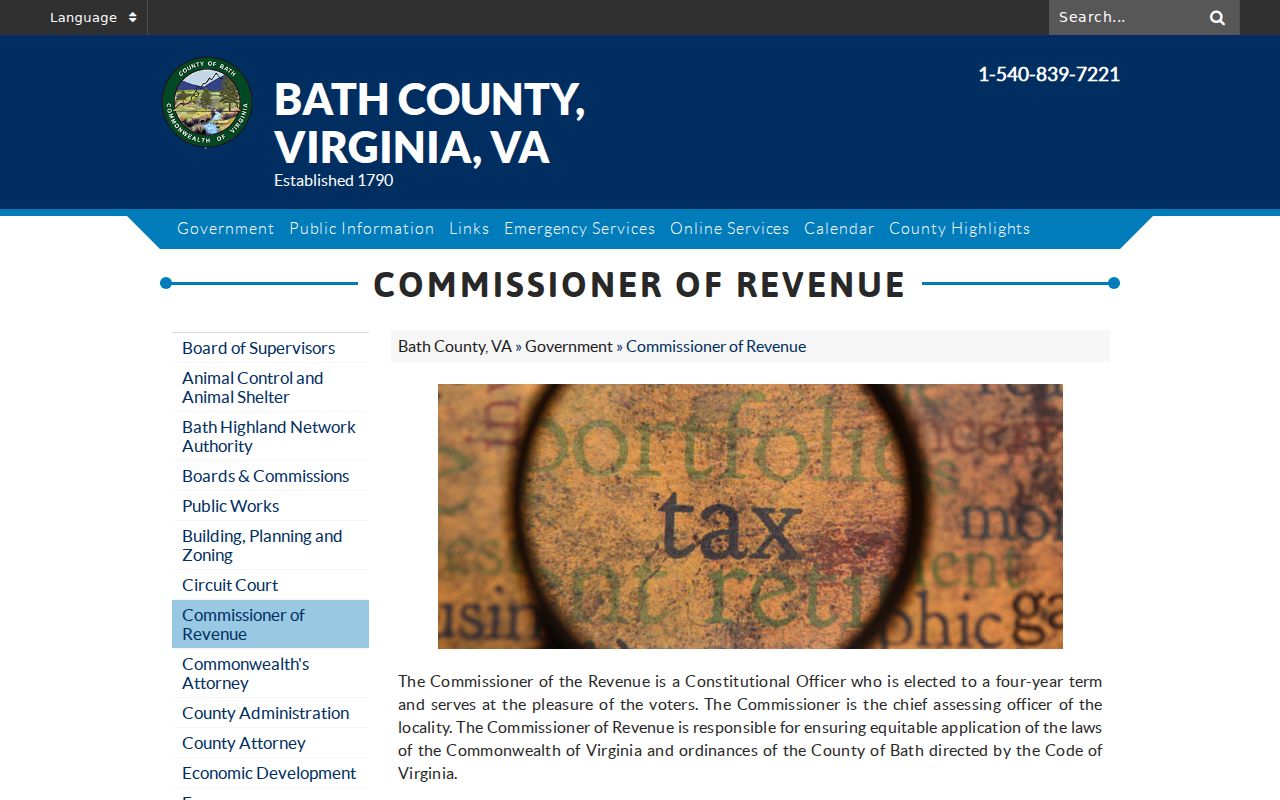
Use the office page to confirm the current assessment contact whenever the vendor portal cannot be reached.
Bath County Owner and Mailing Clues
A tax mailing address and a property's situs address serve different purposes; the situs points to the land for assessment or map display. The mailing address is where notices go. It may be a post office box, a person's home, an LLC contact, an executor, or a bank. Community names and route addresses add another layer. Never read a mailing location as proof that the owner lives on the parcel.
A company in the assessment result deserves a closer look. Search its exact legal name in the Virginia SCC Clerk's Information System. Entity status, a registered agent, and filings can explain the name behind an owner entry. None of that replaces the deed. Trusts, life estates, and estates may be indexed under a trustee, fiduciary, or personal representative. Match the parcel and legal description too. Two same-name entries are not always the same land.
The SCC CIS entity search supplies business filings for Virginia entities. Its result is identity context, not title evidence.
Place a Bath Search on GIS
Bath Planning and Zoning links to a Central Shenandoah Planning District Commission ArcGIS Web App Viewer. Search with whatever location clue you have, then compare the displayed parcel with roads, streams, structures, and adjoining tracts. Test the map's tools directly. Do not assume an adjacent-selection or buffer option exists.
Planning material reports tax-map maintenance and a structural-footprint layer. Those layers orient a search. They do not establish a surveyed boundary. A 2023 survey example uses “P.N. 2303-03” and crosses the Bath-Highland line. That example proves no general numbering pattern. Use the exact parcel number the county supplies.
The official county application and service pages link the Bath GIS viewer. Confirm the recording jurisdiction near a county line.
Confirm Transfers in Bath SRA
Virginia's Secure Remote Access system is called SRA. It opens circuit-court land records from participating counties across the state. The help page draws a line between two levels of service. Clerks who enable it may offer the index for free. Document images are different. The local clerk must approve access, and a subscription fee can apply. Bath's online cutoff and image terms are set locally. So ask the Clerk before assuming coverage. The Virginia SRA help page spells out the free-index versus subscriber-image distinction. The Bath Circuit Clerk can confirm local availability and copy charges.
To trace ownership, search an owner as grantee first. That should surface the acquisition deed. Note the grantor. Note the date, the book and page or instrument number, and the legal description. The grantor then becomes the next prior owner to chase. The index can run dry. An image may be missing. In that case, the Clerk's public record room and the historic Library of Virginia books fill the gap. Remember that the modern online cutoff sits much later than the LVA grantee index. That index runs through 1903.
Bath County Tax and Deed Checks
Once the parcel is identified, take tax questions to the Treasurer. Ownership questions go to the Clerk. The Treasurer prepares and mails tax bills. It also computes penalty and interest on delinquent accounts, and it maintains real-estate tax liens. Its e-Treasurer inquiry is separate from ACT DataScout. Keep tax payment status and proof of ownership apart in any Bath County property search.
The Treasurer’s page displays a rate of $0.67 per $100. Payment dates are June 5 and December 5. Verify the tax year and the current bill before calculating. The page also displays a 2.50 percent card surcharge with a $2 minimum. Ask the Treasurer at (540) 839-7257 about the current ticket, payment record, or lien information.
A newly recorded deed can post before the tax roll catches up. Compare the deed date with the roll date. Do not assume a transfer is missing. The assessment may simply still list the prior owner of record.
Bath County Address and Permit Records
The county posts electronic address-assignment materials. It also posts application forms for building, subdivision, zoning, erosion, septic, signs, demolition, and appeals. Planning and Zoning, on the courthouse second floor, handles E911 and addressing issues. It publishes no address-keyed permit-result database, though. For a permit or inspection history, give the office the address and parcel. Add the applicant and an approximate year.
Address wording shifts over time, so keep both versions handy. Official election listings show postal examples for Warm Springs, Hot Springs, Millboro, and Williamsville. A ZIP marks a delivery area, not a county line or parcel boundary. An old deed may point to a farm, a road, or a run. It may name an adjoining owner rather than a modern street address. Bath's address-assignment records matter when a current number clashes with an older deed. They also matter against an old route number. Planning and Zoning is the local contact for assigned addresses, readdressing, and E911 questions. For permits, the office posts forms but no public results interface. Request the file by owner or applicant name. Add an approximate year if the parcel alone falls short.
A good Bath County property search log pays for itself. Record the source, the search term, the result date, the parcel number, and the next step. Keep old and current road names side by side. Note which address was tried in ACT DataScout. Record which parcel appeared in the map. Jot down which legal description matched the deed. That precision makes the next office request sharper. It also stops a neighboring parcel from standing in for the real subject.
When Bath County Search Needs Help
Each office answers a different slice of a Bath County property search. The Commissioner, at (540) 839-7231, covers assessment data and the correct parcel reference. The Treasurer, at (540) 839-7257, handles bills, delinquency, and tax liens. For deeds, plats, probate material, and older records, call the Circuit Clerk. The Clerk can be reached at (540) 839-7226 or 7227. The Clerk's public record room sits in the courthouse. Office hours run 8:30 a.m. to 4:30 p.m. The court site lists the last recording time as 4:00 p.m.
Older deeds call for a different route. Use the Library of Virginia catalog to identify the right Bath book and grantee index. For an address change, contact Planning and Zoning at (540) 839-7236. These fallbacks matter. No single Bath County property search returns every detail at once. Deeds, taxes, maps, court files, and permits each live in their own place.
Search note. Give the Clerk the road, acreage, adjoining owner, route, and parcel reference when a modern address alone is not enough.
Bath County keeps its online property records in several places. ACT DataScout holds some of them. Virginia SRA holds others. A legacy tax inquiry, the CSPDC map, and county application pages round out the set. One system's result is never the whole story. Treat the parcel number as a bridge between them, not a master key that merges everything into one record.
Some Bath County records simply are not online. For those, contact the custodian directly by phone or at the courthouse. Virginia's public-record request rules govern what public bodies must release, and land-record index and image access also follows the Clerk's recording and SRA arrangements. Before you call, nail down the record type, the property, the approximate date, and any instrument reference. A vague request sent to the wrong office will only slow you down.
Each office has its lane. The Bath Circuit Clerk page lays out the record-room route. The Commissioner answers assessment questions. The Treasurer handles ticket status. Planning and Zoning covers permits and addresses. When a portal is blocked or its fields make no sense, a direct request to the right custodian is the reliable fallback.